2025 AHA Multi Student Skills Checklists
American Heart Association
$9.99
(No reviews yet)

Write a Review
American Heart Association
2025 AHA Multi Student Skills Checklists
2025 AHA Multi Student Skills Checklists
This is a Google Spreadsheet digital version of all the AHA 2025 Skills Checklists that need to be submitted with the roster. These include BLS for 1 through 9 students, ACLS for 1 through 9 students and PALS for 1 though 9 Students.
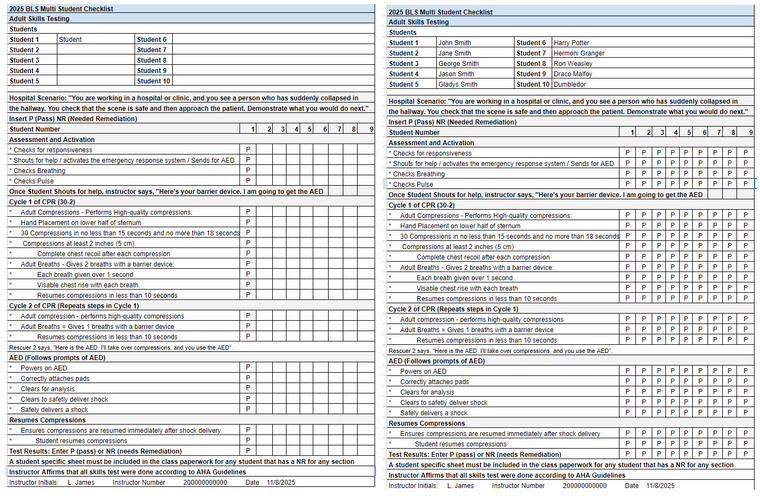
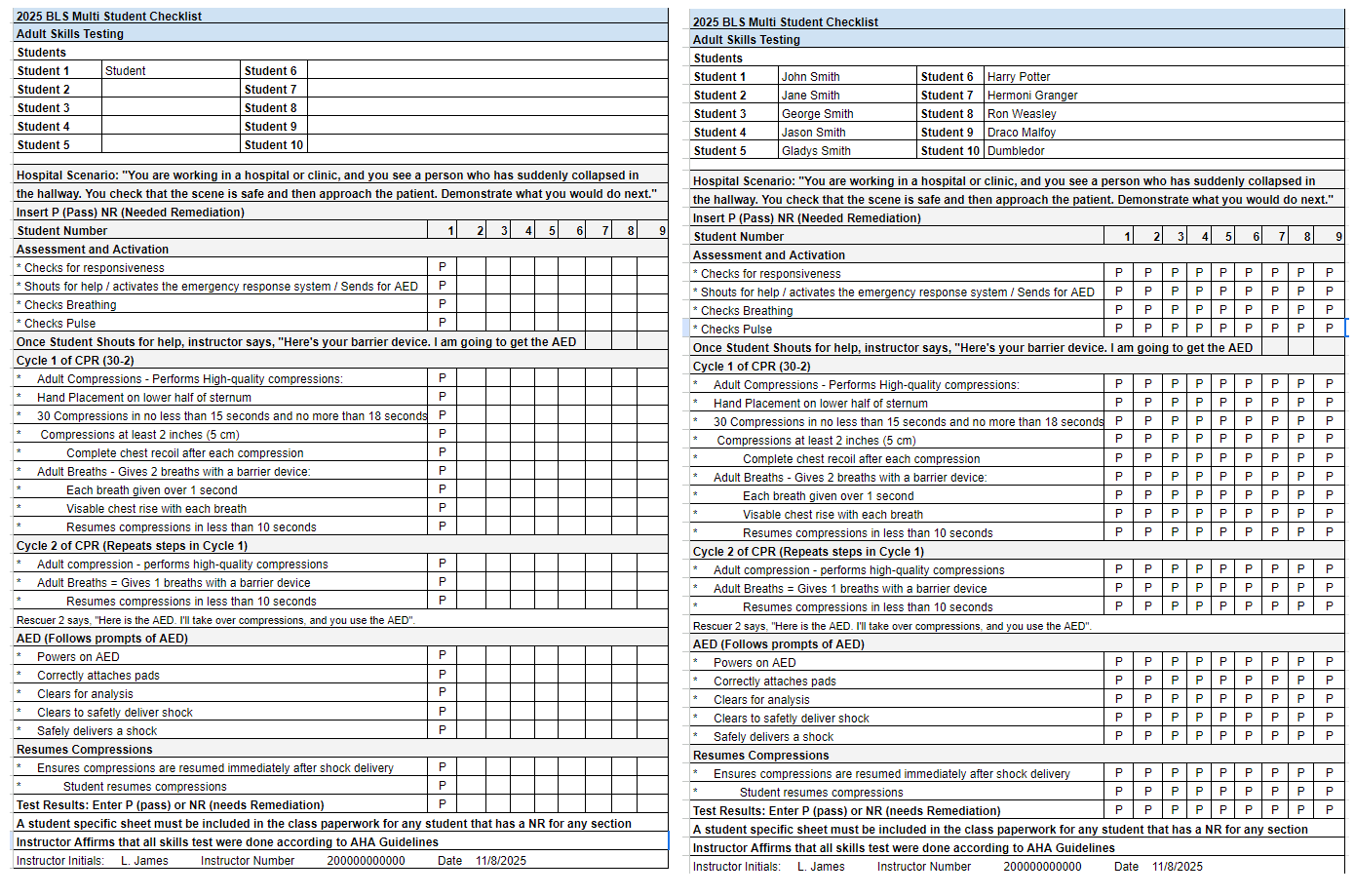
Here's a sample picture of 1 page of the BLS for 1, and 1 page of the BLS for 0 students. All you have to do is copy paste the student name for each page, then enter the instructor, ID and date, and copy paste that line and save to your computer. No more printing 78 pages for a 8 student PALS Class!
I created these from each of the 2025 Guidelines Skills Checklists from AHA. If a student makes a mistake, just click on the "P" and place an "X" in that spot.
A 2025 AHA Student Checklist isn't one single document but refers to the skills & knowledge checklists within new American Heart Association (AHA) CPR/ECC training materials, updated with 2025 guidelines, focusing on high-quality CPR, AED use, team dynamics, and new science for adults, kids, and infants, ensuring students can perform correct actions like chest compressions (100-120/min, correct depth/placement) and effective breaths with visible chest rise. These checklists guide skill testing, ensuring students meet standards for rescue skills, including scenario-based performance, notes for remediation, and recording team metrics like Compression Fraction.
Key Elements on a 2025 AHA Student Checklist:
- Scene Safety: Scanning for hazards and verbalizing safety.
- Responsiveness: Tapping and shouting to check if the person is okay.
- Call for Help/AED: Shouting for help and sending someone to call 911 and get an AED.
- Breathing Check: Checking for no or abnormal breathing (gasping) for 5-10 seconds.
- High-Quality CPR:
- Compressions: 100-120/min rate, correct hand placement (lower half of breastbone), full chest recoil.
- Breaths (with barrier): Opening airway (head tilt-chin lift), 1 second per breath, visible chest rise, resuming compressions quickly.
- AED Use: Powering on, attaching pads correctly, following prompts.
- Team Dynamics: Performing high-performance CPR as part of a team, recording Compression Fraction (CCF).
- Specifics: Checklists cover Adults, Children (1 year to puberty), and Infants (under 1 year, excluding newborns).
How Students Use Them:
- Skills Testing: Instructors use these checklists to mark successful completion of each step during practical exams.
- Remediation: Blank boxes indicate skills needing extra practice (remediation).
- Guidance: They provide clear steps for responding to emergencies, from basic life support to team-based care.
In short, the checklist ensures you've mastered the updated science and skills to save a life.
Related Products
-
-
AHA BLS Skills Session Heartcode BLS Parts 2 and 3 - 2025 Guidelines
$50.00American Heart Association
-
-